Spider veins and small varicose veins
Treat the veins you can see and, when possible, keep the saphenous vein
An in-office treatment with no incisions and no hospital stay, combining laser with a chilled glucose solution. It always starts with an ultrasound, which shows whether this approach suits your legs.
Based on a study published by the physician herself: Sathler de Melo & Faccini, Journal of Vascular Surgery: Venous and Lymphatic Disorders, 2026. Presented at the International Vein Congress, Miami, 2025.
Is it for you?
It all starts with the size of the vein
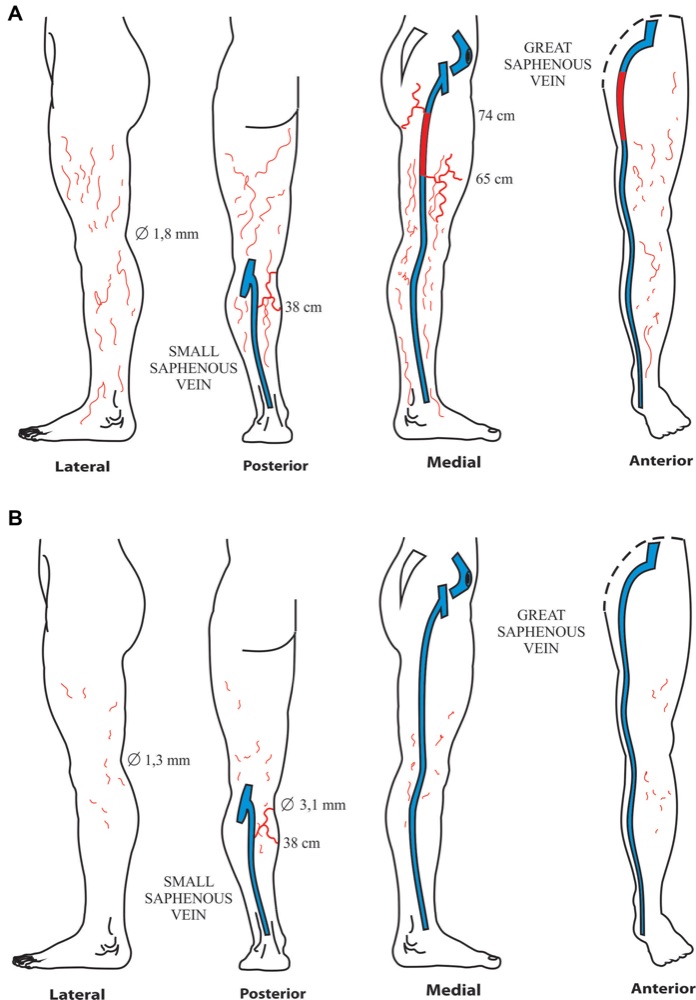
Doctors grade leg veins in stages. The study treated two of them: spider veins (stage C1) and varicose veins up to about half a centimetre, which the research called C2 low. Thicker varicose veins, C2 high, call for a different conversation.
Illustrative drawings, not to scale. These are not patient photos.
In the clinic, the most common profile is a woman who is bothered by how her legs look and wants to deal with it without surgery. The protocol was designed for this group.
Why the ultrasound comes first
Not every varicose vein means removing the saphenous vein
The great saphenous vein is the longest vein in the leg. For a long time, people with varicose veins were told it would have to be removed or closed. Studies show that in many women with small veins, the saphenous problem affects only a short segment, not the whole vein.
That is why the first step is a Doppler ultrasound map, done standing up. It shows where blood is flowing backwards (what doctors call reflux). With that map, the visible veins can be treated and, when possible, the saphenous vein kept, in line with recent guidelines from American societies that favour preserving it (Gloviczki, J Vasc Surg Venous Lymphat Disord, 2024).
How it works
Heat, cold and glucose in the same session
The technical name is long: hemodynamic hybrid laser cryosclerotherapy, or HHLCS. The idea is simple: three agents working together on the same vein.
Laser
An infrared laser passes through the skin and heats the vein from the inside, which makes it shrink. The skin is cooled at the same time to protect it and reduce pain.
Chilled solution
For larger veins, the solution is chilled until it becomes a semi-solid paste. The cold appears to increase the effect on the vein wall.
Moderate-strength sclerosant
The injected substance is concentrated glucose. It irritates the vein wall until the vein closes and stops showing.
Step by step
What happens on the day
- 1
Ultrasound map
A Doppler scan done standing, to see the deep and superficial veins and locate each point of reflux.
- 2
Photos and marking
Standard photos from the front, side and back. A light device shows veins on the skin that the eye cannot see, and they are marked with a white pencil.
- 3
Laser
The laser is passed over the marked veins. The settings are adjusted for each type: spider veins, bluish veins or small varicose veins.
- 4
Chilled glucose
Whatever remains after the laser receives the glucose solution through very fine needles. Because the vein has already shrunk, little liquid is usually needed: for most patients in the study, an estimated less than 5 mL per session.
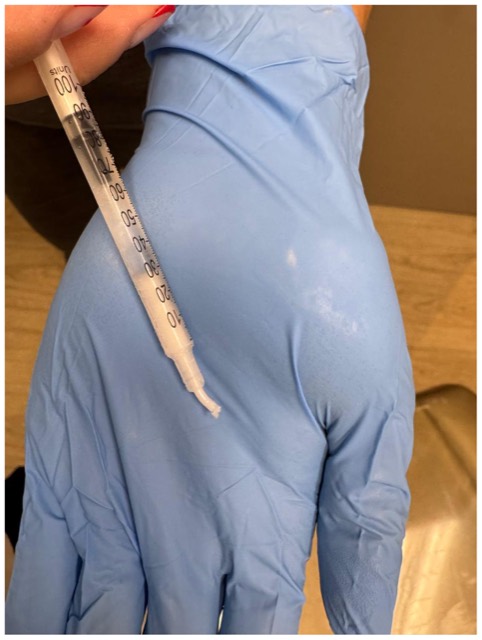
Chilled glucose becomes semi-solid, like a paste (Sathler de Melo & Faccini, J Vasc Surg Venous Lymphat Disord, 2026).
In the study, each session lasted 60 to 90 minutes. Aftercare, such as walking and wearing compression stockings, is explained at the consultation.
What the study found
41 women, followed for 3 to 12 months
Between February 2022 and November 2024, 41 women aged 23 to 79 were treated with the protocol, in 70 sessions in total (Sathler de Melo & Faccini, J Vasc Surg Venous Lymphat Disord, 2026).
How to read these numbers. The study reviewed cases already treated, at a single centre, and improvement was judged by the physician together with each patient by looking at the photos, without an independent assessor. There was also no comparison group. It is a good first sign, but the authors themselves call for larger studies to confirm it. 7 of the 41 patients did not reach 70% improvement. The improvement in saphenous reflux was a secondary finding, because the study was not designed to measure it. Everyone responds differently, and no result can be guaranteed.
Safety
What can happen, plainly
What the study recorded
- Dark marks on the skin were the most common effect. All of them faded on their own over time.
- No cases of skin wounds, light patches or allergy.
- Two thromboses (a clot in a vein) among the 41 patients. One needed no medication; the other was treated with an anticoagulant (blood thinner) for 3 months and recovered fully.
What changed after that
Both patients had risk factors for thrombosis, measured on a scale called Caprini. Since then, patients with that risk receive a preventive anticoagulant for 7 days after the procedure.
Every patient with any complaint after treatment had an ultrasound to check. The authors believe this active search explains why they found more cases than expected.
Common questions
What patients ask
Does it hurt?
The skin is cooled during the laser precisely to protect it and reduce pain. The glucose solution can be mixed with a local anaesthetic. The feeling varies from person to person, and this is discussed at the consultation.
How many sessions will I need?
In the study, 1 to 5. The number depends on how many veins there are, their size and how your body responds. An estimate is only possible after the ultrasound and examination.
Glucose? Is it really sugar?
Yes, it is highly concentrated glucose (67% to 75%). It is considered a moderate-strength sclerosant. No patient in the study had an allergic reaction.
Will my saphenous vein need to be removed?
Not necessarily. With small varicose veins, reflux is usually limited to a short segment of the saphenous vein, and the protocol was designed to preserve it. The specialist decides, based on the ultrasound map.
Can I go back to work the same day?
The procedure is done in the office, with no hospital stay. Instructions for the following days, such as exercise, sun and heat, are individual and given in writing at the consultation.
Is the result permanent?
Venous disease is chronic: treated veins close, but new ones may appear over the years. That is why regular follow-up visits are part of the care.
Assessment
Start with a map of your legs
The first consultation includes a conversation, an examination and a Doppler ultrasound. Only after that is it possible to say whether this treatment is right for you. Consultations are in person in Nova Lima, near Belo Horizonte, Brazil.
- Location
- Angiovasc · Rua Mario Vrandecic, 240, sala 304 · Nova Lima, MG, Brazil
- +55 31 99284-5963
- @draclaudiasathler